
Welcome to Altered, a trading card game in which you lead two Expeditions across lands transformed by the Tumult. Your goal : reunite your two Expeditions before your opponent does.
This page is an expanded transcription of the “Altered TCG — Quick Rules 3.0” booklet published by Equinox (2025). Download the complete rules (PDF, v5.0) — English only
1. Presentation


Altered is a trading card game in which each player uses a deck led by a Hero or Heroine card. Several ready-to-play starter decks are available, but you can customize them or build an entirely new deck.
Game overview
You lead two Expeditions that explore the lands transformed by the Tumult :
- The Hero Expedition, led by your Hero/Heroine and represented by the Hero Expedition marker .
- The Companion Expedition, represented by the Companion Expedition marker .
The Expeditions advance toward each other over the course of the game. Your goal is to reunite them before your opponent does.
The 6 factions
Each Hero/Heroine belongs to one of the game's six factions. Each faction has two Expedition markers : the left marker is the Hero marker, the right one the Companion marker.


2. Materials
Here is a list of game items you might see while playing. Depending on your deck, not every item is required.
For each player

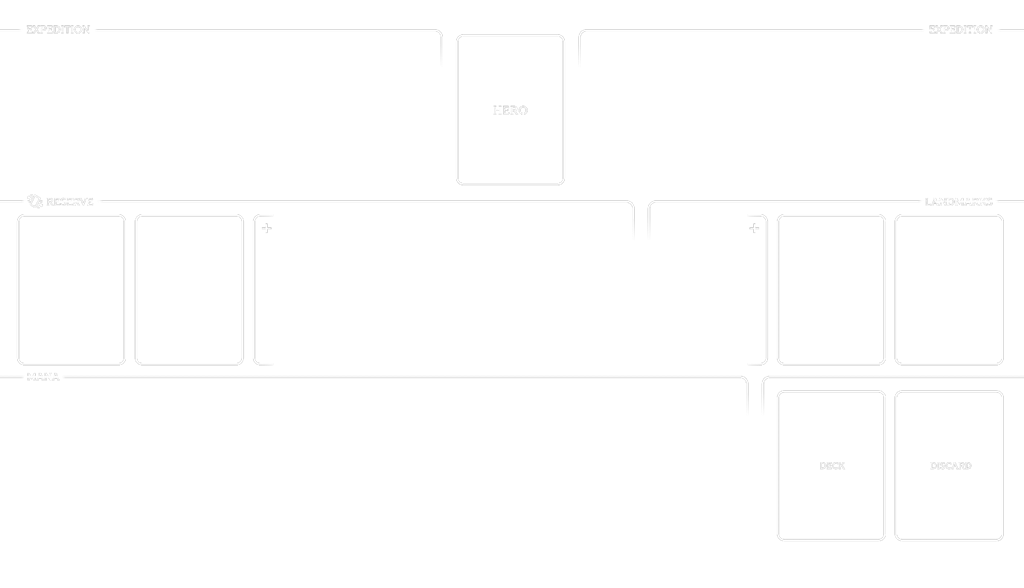 1 playmat optional
Recommended for beginners : it helps visualize the different play zones (Expedition, Hero, Reserve, Landmarks, Mana, Deck, Discard).
1 playmat optional
Recommended for beginners : it helps visualize the different play zones (Expedition, Hero, Reserve, Landmarks, Mana, Deck, Discard).
 1 Hero or Heroine card
Determines your faction and your play strategy.
1 Hero or Heroine card
Determines your faction and your play strategy.


For both players
5 Adventure cards
2 starting regions (Hero and Companion) + 3 Tumult cards.


 Token cards
Brassbugs, soldiers, etc. — created by other cards during play.
Token cards
Brassbugs, soldiers, etc. — created by other cards during play.
Depends on the decks played
Depends on the decks played


Depends on the decks played
Depends on the decks played
3. Setup


- Set up the two playmats facing each other, leaving space between them for the Adventure card row.
- Place the Hero starting region card at one end of that space and the Companion starting region card at the other end.
- Shuffle the three Tumult cards and lay them face-down between the two starting region cards.
- Each player places their Hero Expedition marker and Companion Expedition marker on the corresponding starting regions.
- Each player places their Hero or Heroine card in the Hero zone of their playmat.
- Randomly determine who starts the game, and place the First Player marker on their Hero/Heroine card.
- Each player shuffles their deck and places it face-down in the Deck zone.
- Keep the remaining token cards and markers within reach.
Starting hand
Draw 6 cards from your deck, then choose 3 to place in your Mana zone, face-down and ready. The other three cards form your starting hand.
4. Mana Orbs
- Cards in the Mana zone are always face-down and are called Mana Orbs.
- Each Mana Orb gives 1 Mana when it is exhausted.
- Your Mana Orbs are readied at the start of each Day (see §8).
- A face-down card in the Mana zone stays there until the end of the game.
5. Game zones
The playmat features several zones, each with a specific role during the game. Here is an overview : click the numbers on the playmat to jump to the matching description.
This is where you place your Hero or Heroine card at the start of the game. This card stays there for the whole game and can be used to activate its special ability.
At the start of the game, the First Player marker is placed on the starting player's Hero card.
Two zones, one for the Hero Expedition and one for the Companion Expedition. When you play a Character, you choose which Expedition to place it in.
Characters in these zones contribute to the Expedition's statistics at Dusk to move the corresponding Expedition marker forward.
A face-up zone that works like a second hand. Characters resting at Night arrive here, and Spells played are sent here after resolution.
A card in the Reserve can be replayed by paying its Reserve Cost, but then gains Fleeting. During the Night phase, the Reserve is cleaned up to keep only 2 cards.
The zone where Landmark Permanents are placed. Unlike Characters, Permanents stay in play from one Day to the next and keep producing their effects.
During the Night phase, the Landmarks zone is also cleaned up to keep only 2 Permanents.
The zone where cards used as Mana Orbs are placed. A card put into Mana stays face-down until the end of the game.
Each Mana Orb provides 1 Mana when it is exhausted. All your Orbs are readied at the start of each Day (see §8).
Your draw pile, face-down. You draw your cards from it at the start of each Day.
If your Deck is empty and you must draw, shuffle your Discard : it becomes your new Deck.
Cards set aside during play : Characters discarded from the Reserve or the Expeditions, resolved Fleeting Spells, excess cards from the Reserve cleaned up at Night, etc.
The Discard is a face-up zone : you can look through it at any time.
6. Parts of a card
 A
B
C
D
E
F
G
H
I
A
B
C
D
E
F
G
H
I
There are 4 types of cards : Heroes / Heroines, Characters, Spells and Permanents.
On all cards
- A — Name of the card
- B — Type and sub-type(s)
- C — Faction: there are 6 different factions
- D — Hand Cost: the Mana cost when the card is played from your hand
- E — Reserve Cost: the Mana cost when it is played from the Reserve
- F — Abilities: the card's special rules
- G — Support ability: an ability usable from the Reserve, present on some cards
On Character cards only
H — Characters have statistics corresponding to the three terrain types :
 Forest
 Mountain
 Water
Water
I — Abilities by origin
Cards have various effects depending on where they are played from :
7. Other card types
Spells

When you play a Spell, resolve all its effects, then send it immediately to your Reserve. If you play a Spell from your Reserve, it gains Fleeting: discard it after resolution.
Landmark Permanents

When you play a Landmark Permanent, place it in your Landmark zone. It only returns to the Reserve if a game effect says so.
Expedition Permanents

When you play an Expedition Permanent, place it in one of your Expeditions. At Rest, unlike a Character, an Expedition Permanent only goes to the Reserve if you advanced on that Expedition.
8. A day of exploration
A game of Altered is played over several rounds called Days. Each Day is made up of five phases :
 Phase 1 — Morning
If it is the first Day of the game, go straight to the Noon phase. Otherwise, follow these steps :
- Pass the First Player marker to the other side.
- Ready your Mana Orbs and your exhausted cards.
- Draw two cards from your deck.
- Starting with the side holding the First Player marker, each player chooses whether to place a card from their hand into their Mana zone.
 Phase 2 — Noon
Activate all cards in play with an “At Noon” effect.
 Phase 3 — Afternoon
Starting with the holder of the First Player marker, both sides play one after another, one card at a time.
Turn structure
Quick actions
There are two kinds of quick actions :
- Exhaust ability: present on some Permanent or Hero cards. Exhaust the card to activate its effect.
- Support ability: usable if the card is in the Reserve. To activate it, discard the card from your Reserve.
Playing a card
To play a card, you must exhaust the number of Mana Orbs matching its cost.
- Playing a Character: decide which Expedition to place it in (Hero or Companion).
- Playing a Spell: resolve all its effects, then send it immediately to your Reserve.
- Playing a Landmark Permanent: place the card in your Landmarks zone.
- Playing an Expedition Permanent: decide which Expedition to place it in (Hero or Companion).
- Playing a card from the Reserve: see The Reserve.

Don't forget to resolve any , or effects on the Characters and Permanents.
Pass
If you cannot or do not wish to play a card, you may pass. You then can't take any more turns until the next Afternoon phase. When you pass, your opponent can keep playing. Once they have also passed, the Dusk phase begins.
 Phase 4 — Dusk
During Dusk, both sides compare the statistics of the Characters in play to determine which Expedition markers can move forward.
Starting with one Expedition (Hero or Companion), carry out the following steps :
)
of the region where your marker is located.Then proceed the same way for the remaining Expedition. Your opponent does the same for their Expeditions.
- Your total must be higher than 0 in order to move forward.
- Asleep Characters
 are not counted in the statistics.
 - Each Expedition can only move forward once per Dusk phase.
- When an Expedition moves onto a face-down Tumult card, flip it face-up.
- You always compare your Hero Expedition with your opponent's Hero Expedition, even if the two markers are not in the same region. The same goes for Companions.
Example — Mike vs Ella


Ella therefore cannot advance via
Mountain
but can prevent Mike from advancing there.
B Next, add up each Expedition's statistics for each of these terrains :
| Terrain | Mike | Ella | Result |
|---|---|---|---|
| Forest |
3 | 1+1 = 2 | ✓ Mike wins in Forest |
| Mountain |
3 | 3+1 = 4 | ✕ Ella blocks Mike |
| Water |
3 | 3+1 = 4 | ✓ Ella wins in Water |
C Since his Forest total beats Ella's, Mike's marker advances. On her side, since her Water total beats Mike's, Ella's marker also advances. Both players progress on their Hero Expedition this Day.
 Phase 5 — Night


At Cleanup, discard the excess from the Reserve and Landmarks to keep only 2 per zone.
Rest
Send all the Characters from your Expeditions to your Reserve.
- If they are Fleeting, discard them instead.
 Boost markers are removed from the card before it returns to the Reserve.
- Cards carrying an Asleep or
 Anchored marker do not go to the Reserve : they lose their Asleep/Anchored marker instead and stay in the Expedition.
Send to the Reserve all the Expedition Permanents placed in an Expedition that advanced.
Set aside — not in the Reserve — the token cards from your Expeditions.
Cleanup
- If you have 3 or more cards in your Reserve, discard the excess to keep only 2 cards of your choice.
- Likewise, sacrifice cards from your Landmarks to keep only 2.
Check victory
See Ending the game.
9. The Reserve
The Reserve is a face-up zone that works like a second hand.
Playing a card from the Reserve
A card in your Reserve can be played as if it were in your hand, with two differences :
- You pay its Reserve Cost instead of its Hand Cost.
- A card played from the Reserve gains Fleeting (unless it is a Landmark Permanent).
Fleeting
If a Fleeting card would normally be sent to the Reserve, discard it instead. For Characters: place a Fleeting marker on the Character as a reminder.
A card reading “Discard target Character” cannot target a Character in the Reserve, but a card reading “Discard a target card in a Reserve” can.
10. Ending the game
The first player to reunite their Hero Expedition and Companion Expedition wins the game at the end of the Day.
In case of a tie
If both opponents' markers met up on the same Day, first check whether one of them advanced further than necessary. If that's the case for one but not the other, the one who did wins the game.
The Arena — ultimate tiebreaker

Otherwise, play an extra Day in the Arena to break the tie. The Arena is on the back of the Companion starting region card. Place it in the center of the table, put both sides' Expedition markers on it, and remove the other Adventure cards from the game.
Then play a Day normally. At Dusk, for each Arena terrain
(
),
add up the statistics of the Characters in both your Expeditions.
Compare the three totals with your opponent's: whoever wins
in the most terrains wins the game.
If both sides are tied again, start a new Day in the Arena.
11. Additional rules
Card abilities
If a card's abilities contradict the general rules, follow what is written on the card.
Targeting
Card abilities target cards in play by default — Characters in an Expedition or Permanents in the Landmarks zone.
Cards in the Reserve are not controlled and can only be targeted by an ability that explicitly mentions the Reserve.
Out of cards in your deck?
At Noon only, if your deck is empty, shuffle your discard, which then becomes your new deck. Then draw the required number of cards.
Permanent from the Reserve
If you play a Landmark Permanent from the Reserve, pay its Reserve Cost. It does not gain Fleeting.
“At Noon”, “At Dusk”, “At Night”
These abilities trigger at the beginning of their respective phase. The side holding the First Player marker resolves theirs first, in the order of their choice.
“I” in abilities
Cards use “I” to refer to themselves. For example, “I gain 2 boosts” means “This card gains 2 boosts”.
Support ability
A Support ability triggers only when you discard the card as a quick action, not if the card is discarded for another reason (for example if you have too many cards in your Reserve during the Night).
Token cards
Token cards don't start in your deck but are created by other cards.
When a token card leaves its associated zone, it is removed from the game — a token card is never send to the Reserve or to the Discard pile.
12. Markers & icons
Game markers
Removed when the Character leaves the Expeditions.

Removed when the Character leaves the Expeditions.
Card icons
Terrains
13. Keywords
- Anchored — During Rest, an Anchored Character is not sent to the Reserve; it loses Anchored instead.
- Ascend — Until Rest, an Ascended Expedition can move forward even with statistics equal to the opposing Expedition on the terrains of its region. It still cannot move forward with statistics of 0.
- Asleep — An Asleep Character's statistics are not counted during Dusk. During Rest, an Asleep Character is not sent to the Reserve; it loses Asleep instead.
- Augment — If the target card has at least one counter (Boost, etc.), it gains one more. Hero cards cannot be targeted.
- Contact — A Character is In Contact if one of the opponent's Expeditions is in this Character's region.
- Cooldown — If the card goes to the Reserve after its effect resolves, exhaust it.
- Defect — A Character that Defects joins the Expedition facing it and changes controller (but not owner).
- Defender — An Expedition containing a Character with Defender cannot move forward during Dusk.
- Eternal — An Eternal Character is not sent to the Reserve during Rest.
- Exhaust — An exhausted (90°-turned) card in the Reserve cannot be played and has no Support abilities.
- Exhausted Resupply — Resupply, then exhaust the resupplied card.
- Fleeting — If a Fleeting card is sent to the Reserve, that card is discarded instead. This applies at Rest or due to an in-game effect. All cards played from the Reserve gain Fleeting, except Landmark Permanents.
- Gift — You make a Gift if, during your turn, an opponent draws a card, Resupplies or receives a token via an effect of a card you control.
- Gigantic — A Gigantic Character is present in both your Expeditions.
- Resupply — Place the top card of your Deck in your Reserve.
- Rush — Immediately play another card.
- Sabotage — Discard a target card from a Reserve.
- Sacrifice — Discard a target card from one of your Expeditions or your Landmark zone.
- Seasoned — A Seasoned Character keeps its boosts when sent to the Reserve from the Expedition zone.
- Scout X — This card can be played from your Hand for X mana with the additional effect Send me to the Reserve.
- Support ability — Written at the bottom of some cards on a coloured background, a Support ability requires the card to be in the Reserve. It may need to be discarded () to trigger its effect, or apply continuously ().
- Tough X — An opponent cannot choose a Tough X object as the target of an effect they control unless they pay X additional mana.
