
Formats Contest — Meet the Four Submissions and Vote
It's an important moment for the community. On May 20, Altered Re:Union officially took over Altered on BGA — a fully volunteer team picking up the torch and keeping the game alive. And we’re not stopping there: it’s now up to you, the players, to shape what comes next.
Right now, the Standard All Uniques format is running temporarly — expected to last only about two weeks. What replaces it? The two winners of this Formats Contest, which will then enter a community testing phase — played, stress-tested, and refined by you to decide whether one of them can become the new competitive and Arena format. The community designs the formats, the community votes, the community plays them, and the community decides what sticks. This really is your chance to shape what comes next.
Four teams answered the call for submissions (closed May 24) with complete, thoughtful proposals. Four very different visions, one shared question: how do we make uniques accessible to everyone — no digital ownership — while keeping competitive play healthy and fun?
Below, the four formats following the same order as displayed by the submission threads on discord. Read them, talk about them, then go vote — this is yours to decide.
Frontier — A rotating, shared pool
📄 Full submission: Frontier_Submission.pdf | Frontier_Presentation.pdf
Team: Aran · noobiwow · [AJT] zerosuitsamuss · WildChild · [AJT] Matata
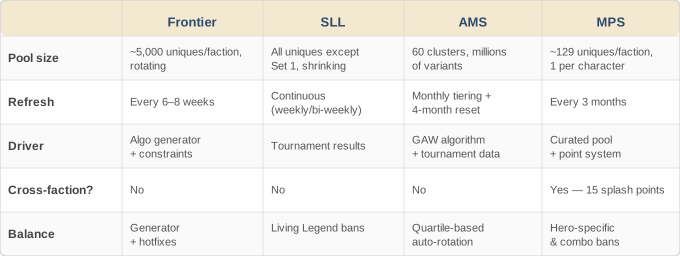
The idea in one sentence. Every 6–8 weeks, an algorithm draws a fresh pool of ~30,000 uniques (5,000 per faction) from Altered's 5 million Uniques — creating a shared, temporary legal pool that rotates each season.
How uniques work. During deckbuilding, a filter restricts every player’s unique choices to the cards in the current pool. Standard deckbuilding rules apply otherwise. Pool generation is bounded random selection with explicit constraints (faction balance, set distribution weighted across CORE/ALIZE/BISE/CYCLONE/DUSTER, and an exclusion list).
Problematic cards. Three layers: an exclusion list at generation (active Equinox bans + Frontier-specific exclusions), a narrow in-season hotfix policy (ban updates allowed in the first 2 weeks of a season, then only for game-breaking interactions), and targeted constraints to keep historically weak heroes supported.
What it promises. A regularly refreshed meta — every rotation is a “new set release” feeling, a fresh puzzle to brew. New players can be competitive on day one with zero unique collection. Statistical analysis backs the generator’s stability (pool entropy, low top-1 share, ~70% overlap between consecutive pools).
Simple Living Legend (SLL) — A self-balancing tournament format
📄 Full submission: Simple Living Legend.pdf
Team: Rinku · Haalford · Benhol · Cohlrabi · Chile · The Kelon Guy
The idea in one sentence. Start with all uniques legal (except Set 1), then let tournament results progressively “Living Legend” (ban) the uniques in the best-performing decks until the meta self-balances.
How uniques work. At launch, every unique from Sets 2–5 is available. After each Reunion-approved tournament with 8+ players, the top decks (1 deck per 4 players, rounded up to the nearest power of 2) have their uniques “Living Legend’d” — i.e. removed from the legal pool. A community vote decides whether this happens weekly or every two weeks.
Problematic cards. A “similar text” rule: if 10%+ of LL’d uniques share an identical text, all uniques with that text get LL’d together. A community-elected oversight group of 3–5 people (from Reunion OP/competitive team or volunteers) can adjust the LL rate, the frequency, the % threshold, and other parameters.
What it promises. A format that curates itself through actual play, no algorithm or committee deciding what’s “too good.” Competitive players keep the thrill of searching for the unique that makes their deck work — but the strongest uniques won’t stay strongest for long. Achievements/badges could reward players who Living Legend cards across factions.
Autobalancing Meta Standard (AMS) — An algorithmic, data-driven format
📄 Full submission: Autobalancing Meta Standard.pdf
Team: Aldenoth · Dragoist · Arestark · Giga · Wisefrank · Laumimian
The idea in one sentence. Instead of legalizing individual uniques, AMS legalizes 60 Character Identity Clusters (10 per faction) — meaning every unique variant of a legal character is playable. An algorithm rotates dominant characters out monthly.
How uniques work. A “cluster” is the set of all uniques sharing the same character name (every Esmeralda, for example). When a character is in the Standard Library, all its unique variants across all sets are legal. Players keep total creative freedom inside legal clusters.
Problematic cards. The GAW engine (Global Ability Weighting) computes a Dynamic Efficacy Score for each cluster, combining stats-to-mana efficiency and win/play rate data (smoothed via Bayesian methods). Tiering uses relative quartiles, not fixed thresholds — Tier S clusters (top 10%) rotate out monthly, lower tiers fill the empty slots with weighted probability. A full reset happens every 4 months, with one “Legacy” character per faction saved by community vote.
What it promises. Newcomers only need to learn 60 names, not millions of card permutations. Tournaments become the “data engines” feeding the algorithm. Mathematically, the format cannot stagnate because tiers are relative — a new strong cluster pushes others down automatically.
Multifaction Point System (MPS) — Cross-faction deckbuilding with a curated pool
📄 Full submission: Multifaction Point System.pdf
Team: Keldeofus · Ajordat · djj · Nox · gabrielbargiel · Heya(s)
The idea in one sentence. Standard rules — but you get 15 special points to splash cards from other factions into your deck (1 pt per common, 2 pts per rare, 4 pts per unique or exalted).
How uniques work. The pool contains 1 random unique per character in both their main faction and their Oof (off-faction), plus additional randomly picked uniques to fill out factions with fewer characters — about 129 uniques per faction. The pool refreshes every 3 months (a poll can adjust this).
Problematic cards. Existing suspensions remain at launch. The format allows banning cards (any rarity) later, including hero-specific bans and combo bans when two cards together are too strong but individually fine. A watchlist already includes Bravos Haven and faction Festivals (especially Ordis).
What it promises. Massive deckbuilding variety: every character has exactly one unique in the pool, so new players don’t need to compare hundreds of variants — just one unique vs. its rare and common siblings. Splashing across factions opens new combos, makes unused heroes viable, and produces an unpredictable, harder-to-solve meta. Compatible with rotation or single-set modes too.
Quick comparison
How and where to vote
Voting period: May 25 to May 30, 2026 (closes at 23:59 UTC).
Results announced: May 31, 2026.
How the vote works
This is a rating vote, not a pick-your-favorite vote. You rate each of the four formats independently on a scale from 1 (strongly oppose) to 6 (strongly support). You don't have to choose between them — express how you feel about each one.
Why this system? It lets you fully back two formats you both love, without forcing a strategic trade-off. It also captures how strongly you feel — a format everyone rates 5 is a stronger consensus pick than one that polarizes between 1 and 6.
The two formats with the highest average rating will enter the community testing phase on BGA, replacing the temporary Standard All Uniques.
👉 Voting take place via this Google Form.
The other two formats will be testable too in the Sandbox mode, and future community votes may bring format rotation.
Read each submission carefully, talk to the teams, brew a few test decks in your head — and then vote for the two visions you most want to see become the new Standard.
